
People worth knowing
Dr. Jeffrey Thompson
A chiropractic physician and musician who has spent four decades asking what sound can do for the body.
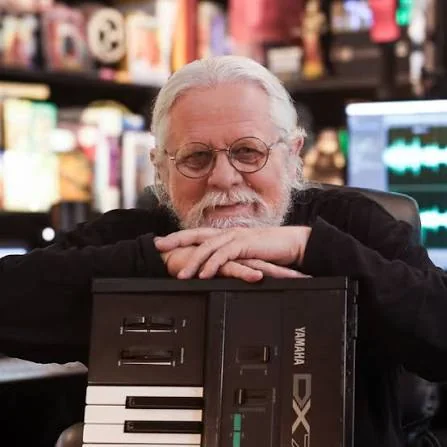
Who he is
Dr. Thompson holds a Doctor of Chiropractic and a Bachelor of Fine Arts, and describes himself as a physician, musician, composer, inventor, educator and author. He founded the Center for Neuroacoustic Research in Carlsbad, California, and has been working with sound in a clinical setting since the early 1980s. He is on the faculty of a graduate school in Encinitas, California, where he teaches behavioral psychoacoustics and clinical neuroacoustic therapy.
The problem he works on
Whether sound — specific frequencies, rhythms and recordings — can be used deliberately to change how the body and the nervous system behave, and how to do that in a repeatable way. His method, which he calls Bio-Tuning, uses frequencies drawn from the responses of the autonomic nervous system, with the aim of reaching what he calls homeostasis: zero stress in this core control system. His site lists more than ninety recordings built on this idea.
What makes the work interesting
Sound is something almost everyone already uses to change how they feel. Dr. Thompson has spent four decades trying to make that systematic, and his site lists collaborations ranging from Deepak Chopra and Louise Hay to NASA/JPL, along with programs at Duke University and the University of Virginia. The interesting question for a reader is not whether sound affects mood — it plainly does — but which effects go further than that, and how anyone would measure it.
The evidence and the context
His site describes the work as clinically proven. Rerouted has not yet read the studies behind that description, so we are not repeating it as a finding of our own. When we have reviewed them, this section will say what was measured, in whom, for how long, and what the results do and do not support. Until then, treat this feature as an introduction to a person and a question, not as a verdict on a method.
In short: what he does, and how people use it
Dr. Thompson's work sits where medicine, music and engineering overlap. Trained as a chiropractor and as a fine artist, he has spent his career building tools that deliver sound to the body in a controlled way: recordings tuned to particular frequencies, and a "sound table" — a treatment table with built-in transducers, which he has been developing since 1989 — so that a person hears the sound and feels it through the body at the same time. His site describes the system, which he calls Bio-Tuning, as patented.
The accomplishments his site lists are mostly about reach and longevity rather than clinical trials: more than four decades of work, a research center he founded and still directs in Carlsbad, California, a faculty position teaching psychoacoustics and neuroacoustic therapy, programs made with well-known names in the mind-body world, a collaboration with NASA/JPL on turning space-probe plasma-wave data into audio, and appearances on Gaia and Prime Video. It is a long and serious body of work in its field. What that field has and hasn't proven is a separate question, and one Rerouted still has to look at properly.
For a reader, there are two ways in. The simpler one is his catalogue of general-purpose recordings — for meditation, sleep, focus, creativity — which anyone can buy and listen to at home on headphones or a player, usually as a daily routine. The more involved one is a personalised Bio-Tuning session: a practitioner measures your heart-rate variability, identifies what his method calls your fundamental frequency, and builds a recording around it; sessions on the sound table run a few minutes, and the personalised recording is then used at home. Those sessions happen in person at his center.
How to use any of this sensibly: treat it as a way to relax and settle the nervous system, which sound demonstrably can do, and be sceptical of anything beyond that until you have seen the evidence for it. Start with the inexpensive option before the personalised one. Ask what a session costs in total, including the recordings, before you book. If you are dealing with a diagnosed condition — anxiety, insomnia, chronic pain, anything cardiac — tell your care team what you are using; sound therapy is low-risk, but it should sit alongside your treatment, not replace it. And if a claim sounds like a cure, ask for the study.
The most useful thing Dr. Thompson offers may be the question his whole career is built on: what can sound do for the body, measured rather than felt? Rerouted will follow that question into the research, and update this page with what it finds.
Who this may matter to
People exploring complementary approaches alongside conventional care, and anyone curious about what the research on sound and the nervous system actually shows. If you use or are considering an approach like this, your care team should know about it — see Complementary Care for the questions worth asking.
Where to learn more
The Center for Neuroacoustic Research — Dr. Thompson's own site, the source for the facts on this page.
Education, not medical, legal or insurance advice.